
These are the best simple bullet journal ideas…the kind that actually work in real life.

If you’ve ever searched for bullet journal ideas and instantly felt overwhelmed… you’re definitely not alone. I’ve been there too.
For the longest time, the idea of starting a bullet journal felt like a lot. There were so many spreads, so many layouts, so many “must-have” pages, and so many rules floating around that I didn’t even know where to begin.
Honestly, I put off starting a bullet journal for a long time because of it.
Somewhere along the way, bullet journaling started to look like this picture-perfect creative project, with pages filled with hand lettering, fancy doodles, color themes, and layouts that look like they were designed by professional artists.
And while those journals are beautiful, seeing them can make it feel like you need major artistic talent and three uninterrupted hours just to plan your week.
That’s enough to stop anyone before they even start.
Here’s the thing that I’ve discovered, though, and this is the part that really matters…a bullet journal was never meant to be complicated.
Simple Bullet Journal Ideas
A bullet journal is simply a system that helps you organize your life in a notebook. That’s it.
It’s a place to keep your to-dos, your plans, your notes, your goals, and sometimes even your scattered thoughts when your brain is going a million miles a minute and you just need somewhere to put everything down.
- No fancy layouts are required.
- No perfect handwriting is needed.
- No pressure to make it look like anyone else’s.
In this post, I’m sharing simple bullet journal ideas. Ideas that are easy to set up, easy to stick with, and genuinely helpful in real life. By the end, you’ll know how to create the kind of bullet journal that supports you so you’re actually more productive and relaxed instead of one that is stressing you out. The kind of journal you’ll actually come back to day after day.
What Is a Bullet Journal?
A bullet journal is a customizable notebook system used for planning, journaling, and organization. It’s built around writing quick, simple bullet-style entries instead of long paragraphs or complicated layouts.
Most bullet journals include some combination of:
- Tasks and to-dos
- Events and appointments
- Notes and reminders
- Habit tracking or goals
- Brain dumps and ideas
And the best part is that your bullet journal can be as minimal or as detailed as you want. There isn’t one right way to do it.
If the most you do is write the date and a few bullet points each day? That still counts. And it still works.
Why a Bullet Journal is So Helpful
Let’s be honest…the reason many people quit bullet journaling isn’t that the system doesn’t work. It’s because they made it too complicated. Now this is not entirely their fault because as I mentioned above bullet journals can look incredibly complicated.
These simple bullet journal ideas are perfect if you:
- Want a calm, easy planning system
- Don’t want it to feel like homework
- Struggle with consistency when things get too detailed
- Want to organize your life without buying a cart full of supplies
These simple bullet journal ideas are sustainable—and that’s what I love about them.
How to Make a Simple Bullet Journal (Step-by-Step)
If you want a clean, simple setup you can follow, here’s how to make a simple bullet journal from scratch.
Step 1: Choose Your Journal
You don’t need the most expensive dotted notebook online. Choose something that feels comfortable and easy to use. There are so many notebooks, so pick something that you love.
Here are some great options:
- A dotted notebook (popular because it helps with spacing)
- A lined notebook (simple and familiar)
- A blank notebook (if you like total freedom)
If you tend to be a perfectionist (fellow perfectionist here), I have a helpful tip for you:
Choose a notebook that doesn’t feel “too special”…specifically if this is your first time making a bullet journal. Trust me, it’s just easier to start when you’re not afraid to mess it up.
Step 2: Select the Spreads You Want to Try
Before you start filling pages, decide what you want your bullet journal to help you with.
For a simple bullet journal, I recommend starting with just:
- Monthly log
- Daily logs
- (Optional) habit tracker(s)
You can always add weekly spreads or any extras later. It’s not necessary to set up your whole year in one sitting (unless you want to).
Step 3: Create an Index Page
On your first page, write Index at the top. As you create new sections in your bullet journal, you can add them to the index section with page numbers.
Here are some examples:
- Monthly Log – page 3
- Habit Tracker – page 6
- Brain Dump – page 10

This is what helps to keep bullet journals organized even when the pages aren’t in perfect order.
Step 4: Create Your Bullet Journal Key
Your key is a simple legend that explains your symbols. I think it’s best to keep this super basic:
- □ Task
- ○ Event
- • Note
- * Important
- ✓ Completed
- ? Question
- → Moved to another day
- ! Reminder
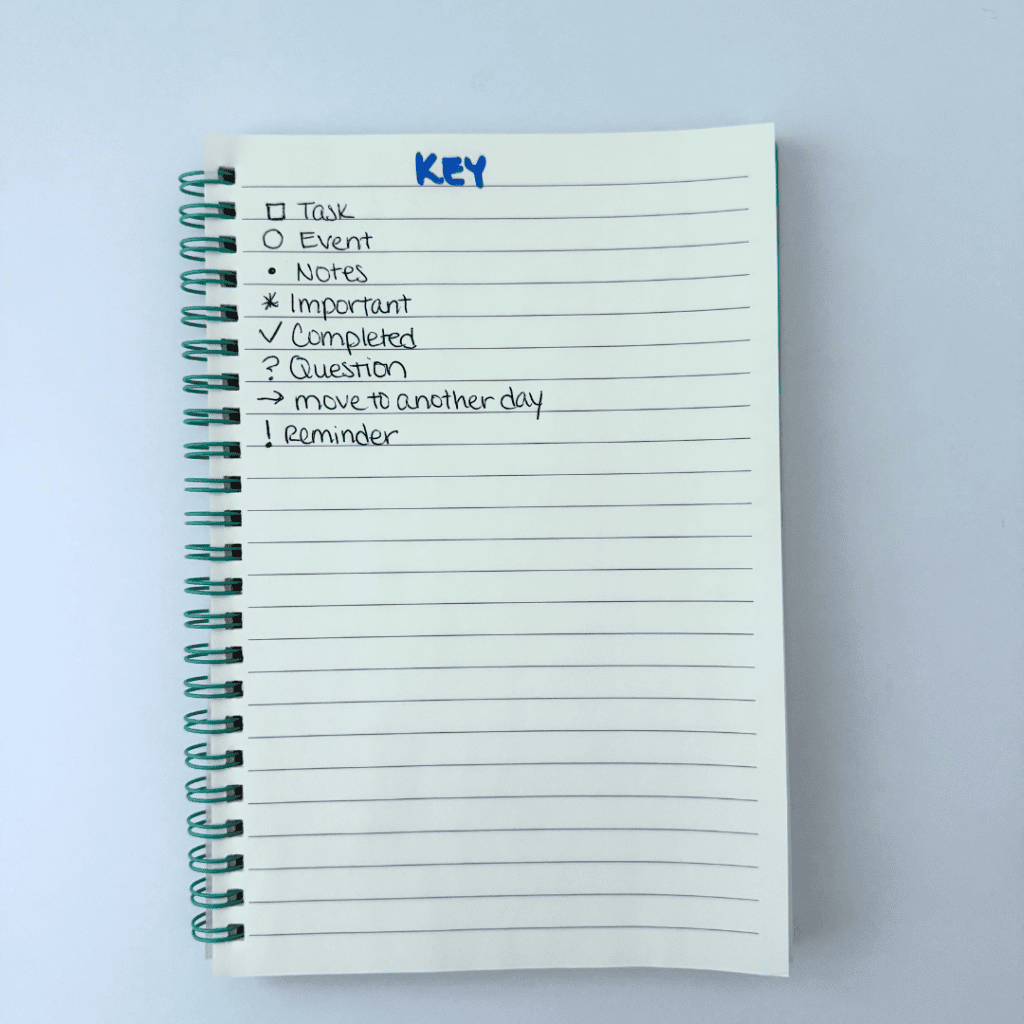
You can change your key at any time. The goal of the key is to make your journal faster to use—not more complicated. Use symbols that make the most sense to you. After all, the whole point of a bullet journal is to help you be more organized, less stressed, and more productive.
Step 5: Create a Journal Habit
In my opinion, this step is by far the most important. You can have the best layouts, the prettiest notebook, and the perfect pens—but none of that matters if you’re not actually using your bullet journal. Consistency is what makes the biggest difference.
Here’s the reality…a bullet journal only works if you use it. And here is the good news…you don’t need an hour a day to make that happen. You just need a small, realistic amount of time you can stick with.
A great way to start is by keeping it incredibly simple:
- Spend 2 minutes in the morning checking today’s plan
- Spend 2 minutes at night moving anything you didn’t finish and writing tomorrow’s date
That’s it. Four minutes total.
And if you’re not someone who loves daily routines, that’s okay too. You can do a quick “reset” a couple of times a week…review what’s coming up, move your tasks forward, and clear your head.
Personally, I get the best results from my bullet journal when I use it every day. Once it became part of my routine, it stopped feeling like something extra I had to do and just became something I do.
No matter which approach you choose, remember this: consistency over perfection. Missing a day doesn’t mean you failed; it just means you pick it back up the next time.
Simple Bullet Journal Ideas You’ll Actually Use
Now let’s get into my favorite part—simple bullet journal ideas that don’t require artistic skills, fancy supplies, or a ton of time. These are the kinds of simple bullet journal spreads that are easy to set up, easy to maintain, and ones that you’ll actually use.
If you’re just getting started, you don’t need to use all of these. Pick one or two and see how they feel. Your bullet journal should support you, not overwhelm you.
1) Daily Log
The daily log is the foundation of a simple bullet journal—and honestly, it might be the only spread you ever need.
To create a daily log, just write the date at the top of the page and list:
- 3–5 tasks you want to get done
- Any appointments or commitments
- Quick notes or reminders
That’s it. This is truly the easiest spread to keep up with. It’s how I started using a bullet journal, and for a lot of people, this simple daily log becomes their entire system.
If all you ever do is write the date and a few bullet points to help keep you on track each day, your bullet journal is still doing its job.
2) Monthly Log
Instead of drawing out a full calendar (which can feel time-consuming and unnecessary), a simple monthly log keeps everything clean and easy.
At the top of the page, write the month. Then list important dates and reminders like this:
December
- 12: Dentist at 2pm
- 18: Holiday party at 4pm
- 22: Pay rent
You can also add a short list of priorities or goals for the month underneath if you want.
Seriously, do not overcomplicate this. The goal of a monthly log is to give you a quick overview, not another thing to manage. Do what is simple and clear.
3) Habit Tracker
A habit tracker is a great way to build consistency for new habits you want to develop without pressure.
To keep it simple, create a small grid with the days of the month across the top and a few habits listed down the side. Check off the days you complete each habit.
If you’re new to bullet journaling, I recommend tracking just 2–3 habits, such as:
- Water
- Exercise
- Sleep
Tracking too many habits at once can feel overwhelming, so start small. You can always add more later once you see what actually works that you’ll stick to.
4) Brain Dump Page
Brain dump pages are hands down one of my favorite parts of a bullet journal.
For your brain dump page, simply title a page “Brain Dump” and write everything that’s taking up space in your head. No structure, no organization, no rules.
Brain dump pages are especially helpful:
- On Sundays, to prep for the week ahead
- During stressful or overwhelming weeks
- When you can’t focus or feel like your mind is going all over the place
You don’t need to organize anything as you write. The goal is just to get it out of your head and onto paper. You can sort through all the brain dump items later…or not at all. Sometimes the simple act of writing them down is enough.
5) Top 3 Weekly Spread
If you like having a weekly overview but hate complicated layouts, this one is for you.
At the top of the page, write:
This Week’s Top 3
Then list:
1.
2.
3.
These should be the three most important things you want to focus on that week.
Below that, you can list appointments or important events if you want. And that’s it, literally that’s the entire spread.
This layout helps to keep you focused without overwhelming you. And it’s perfect for weeks when you want clarity without a lot of structure.
Additional Posts You May Like:
85 Quick Evening Journal Prompts for Before Bed
How to Start Journaling (Best Guide for Beginners)
100 Simple Morning Journal Prompts For A Great Day

Final Thoughts on Simple Bullet Journal Ideas
If there’s one thing to remember as you start (or restart) your bullet journal, it’s this…simple works.
A bullet journal isn’t meant to be perfect, pretty, or packed with pages you feel pressured to keep up with. It’s meant to support your life. It is not supposed to stress you or be another thing to add to your already long to-do list. The bullet journals that are the most effective are the ones that feel easy to use and realistic on even those crazy busy days.
Start with what feels manageable to you and allow your journal to grow with you. Sometimes you might use your bullet journal every day, and other times you might come back to it a few times a week…and both are okay.
The goal of a bullet journal is to help you stay organized and on track, with less stress.
I hope that these simple bullet journal ideas help you to create a bullet journal practice that works for you.




Leave a Reply